
Why I'm not buying SPCX
Breaking my 14 year old heart
I am not licensed to give financial advice and I am not a CFP.
I am, however, a space nerd, and I have been since I was very small. When I was 9 I knew the names of every crewed US capsule and rocket that had ever flown into space. When I was 11 I could name every single pressurised crew module of the International Space Station. When I was 13 I won a science fair for a design proposal for an ISAM Earth-Mars transit mothership1.
And throughout high school, as NASA’s humiliating SLS program dragged on year after year with no results, I was enamoured by SpaceX.
When I was younger I had a distaste for private spaceflight. I saw space exploration as a collective project. I felt it was wrong to attempt to profit off of our first steps into the great expanse that we call the common heritage of mankind.
But SpaceX just kept on winning. Again, and again, and again. I appreciate that there is a lot of hate right now for Elon Musk and his projects (we’ll get to that soon), but if you weren’t following SpaceX’s progress in the mid-late 2010s, then it’s possible you don’t fully understand just how staggering their progress was. Yes, they’ve blown up many rockets, but in a few short years they went from the first commercial ISS resupply mission to the first successfully returned reusable first stage to the first crewed commercial space mission.
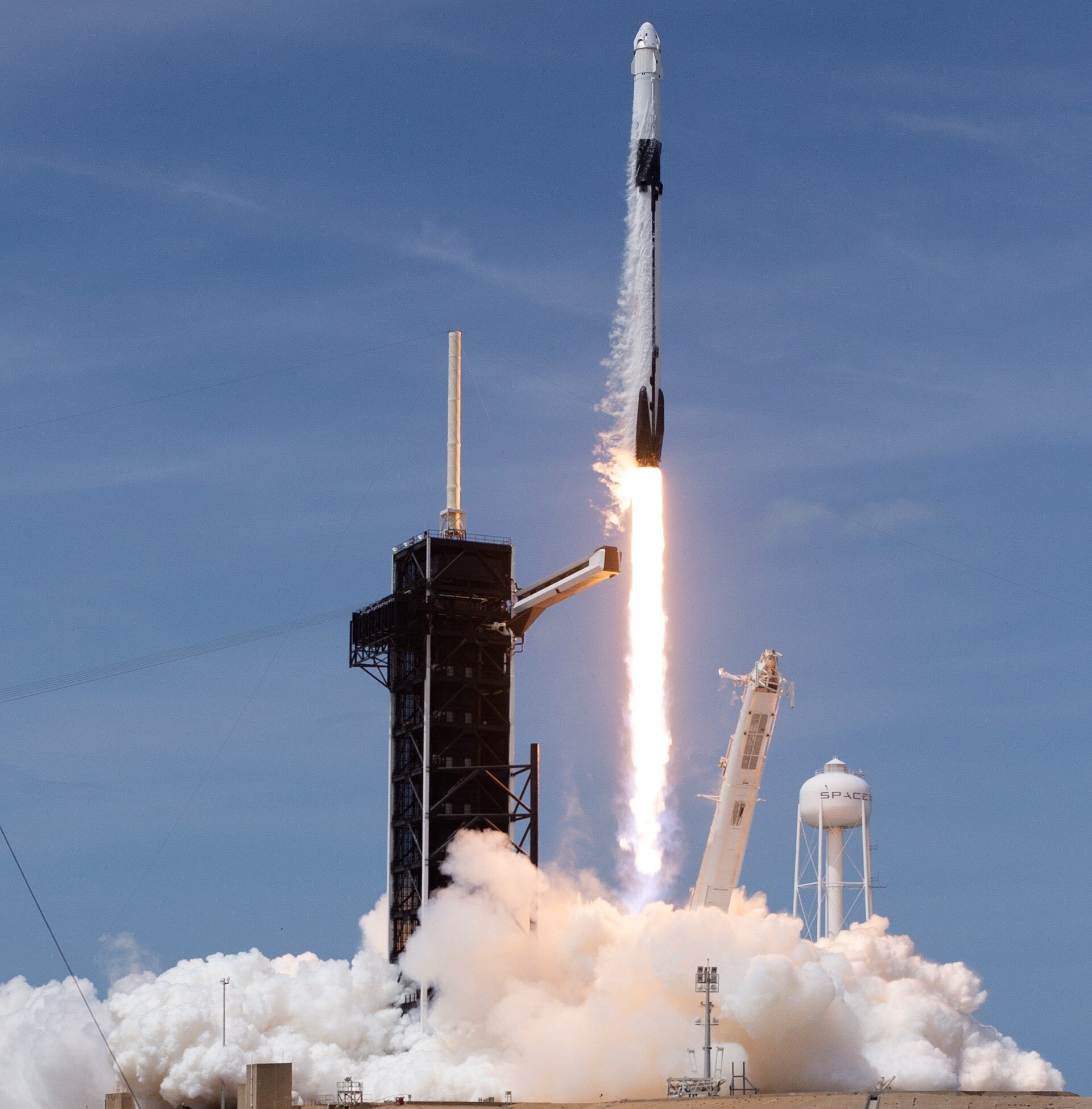
I sometimes wonder when my last ever moment of childlike wonder was. But a very good candidate was the launch of SpaceX Demo-2 on 30 May 2020, five days after my 18th birthday, when I watched live as the United States sent astronauts into space from their home soil for the first time since I was 9.
I’m telling you all this in the hopes that it slightly softens the blow of this very cringe personal confession: for many years, I dreamed of the opportunity to own SpaceX stock. This wasn’t really a financial thesis for me. I simply wanted to be a part of the next stage of the human story, and becoming a co-owner of the clear frontrunner for Western space innovation seemed the easiest way to do so.
If 14 year old me knew that SpaceX would IPO on Friday, 12 June 2026, he’d start saving his birthday money and softball umpiring commissions right then and there. He’d hardly even consider the idea that his adult self a decade later wouldn’t be interested in buying in.
But it’s Thursday, 18 June 2026, and I don’t think I’ll be purchasing SpaceX anytime soon.
Why not?
SpaceX seems pretty overpriced to me
The Space Exploration Technologies Corporation, DBA SpaceX Corp., has a market cap of $2.52 trillion USD at the time of writing. The next top 20 US aerospace and defence firms have a combined market cap just shy of $2 trillion.
That’s obviously ridiculous. In order for this price to make sense we would have to believe that currently and/or in the future, SpaceX does or will produce 25% more value than the rest of its entire sector.
![r/dataisbeautiful - [OC] SpaceX vs. Aerospace and Defense Sector](https://substackcdn.com/image/fetch/$s_!aUQ8!,f_auto,q_auto:good,fl_progressive:steep/https%3A%2F%2Fsubstack-post-media.s3.amazonaws.com%2Fpublic%2Fimages%2Fb1a68b2f-cde9-4aa5-8d5f-c63ef8f975b6_6667x6667.png "r/dataisbeautiful - [OC] SpaceX vs. Aerospace and Defense Sector")
SpaceX provides launch services at relatively cost-effective prices for private entities, the US government, and their in-house satellite internet service, Starlink. They are NASA’s number one launch contractor, they are the only private entity with the technology to launch US astronauts, and it’s undeniable that Starlink changed the world2.
Those are the fundamentals of a fine company. But that’s not a $2.5T company.
From The Motley Fool:
Right now, [SpaceX] is trading at a price-to-sales (P/S) ratio of 130.4. This would be expensive if the multiple was just earnings, but it’s sales.
So in theory, investors are betting that SpaceX’s role in the future will be so enormous as to justify its current price tag. There may be some serious ROI for SpaceX in the far future. But if you asked me “which do you think will be more important to the global economy in 20-40 years? SpaceX spaceships or Lockheed Martin missiles?” I’d have to put my money on the latter.
xAI is not a serious value add, in my opinion
In February 2026, SpaceX acquired xAI in the largest merger in corporate history. So amidst all the talk of SpaceX’s fundamentals and profit centers and future viability, the conversation of SPCX as an investment demands some discussion of “AI hype”.
I do not think that at some point in the next 1-5 years the “AI bubble” will “burst” and all the tech stocks will self-correct back to “normalcy”. I’m emotionally prepared for an AI future. So as a potential investor in SpaceX, I should be more confident in SpaceX for writing a $250B cheque to buy xAI. Surely that’s the responsible thing for a firm to do?
I’d perhaps take that logic if I had any faith in xAI in the first place.
I do not work in AI, but I do work with LLMs quite a bit. And I am confident in saying that Grok is an inferior product to Claude, Gemini, or even ChatGPT. It is very cheap, it does well on benchmarks, and it has X access which is unique. But I have a few problems with SpaceX/xAI as an investment compared to other AI companies:
xAI is not a profit center and it might never be a profit center. Grok is now directly subsidised by rocket launches.
Even if xAI posted a profit in Q3, a lot of that revenue comes from a compute agreement with Anthropic ($15B annually) that could evaporate at any time.
It seems clear that for the short-medium term, most of the revenue for LLMs depends on enterprise sales. Enterprise sales figures for Grok are terrible compared to ChatGPT or Claude; xAI can’t sustain a moat on being the cheapest AI forever.
I have other more emotional, less principled opinions on xAI that I will get to shortly.
But let’s imagine a bullish argument: even if xAI is knocked out of the AI race, SpaceX has ambitions (and the capabilities to realise said ambitions) unmatched by anyone else in the private sector: making humanity an interplanetary species.
I do not see ROI on space colonisation in my lifetime
Speaking of moats: the establishment of a private Martian colony would be quite a moat (a 225 million kilometer moat, to be precise). But moats are only as useful as they are profitable.
Kim Stanley Robinson’s Aurora (2015), as long-time readers will know, is a favourite hard SF novel of mine. A question the story asks of the reader throughout the book is “what is the point of space colonisation, anyways?” Colonisation of new worlds on Earth was motivated by profit: slaves, gold, and useful, arable territory. The Great Powers of Europe went to war with each other over the Americas for good reason. There were great riches to be made in exploration and colonisation.
But where are the riches in establishing a colony on Mars, which is an explicit business objective of SpaceX? Is there some mystical valuable resource there? Is Mars prime real estate with great economic and geopolitical value?
No, of course not. It’s a giant desert. There aren’t even any worms.
As an investor my time horizon is somewhere on the order of 40 years. A Mars colony anywhere in that timeline would be the most expensive project humans have ever undertaken, and for what? The best argument is an insurance policy for the human race against an Earth-destroying extinction event. But for Robinson, the answer to that question is “vanity”. Mars colonisation is a pet project.
I like pet projects, to be clear! No one ever asked the Apollo program to produce a PnL and pay dividends. As a cosmist I believe humanity will figure out solutions to all the very hard problems with Mars exploration. But as an investor I do not believe SpaceX will figure out those solutions, AND make them profitable within 40 years or so. And if I do not believe that, then any faith I have in SpaceX’s Mars-oriented growth is a speculative argument. And I do not engage in financial speculation.
And sure, Starlink and US contracts are the meat of SpaceX’s revenue, and likely will be into the future. But if SpaceX’s actual mission statement points at something that’s probably not profitable, that tells me something about the judgement of its leadership as a for-profit enterprise.
In 2026, you have to bet on people
I am an investor in the Costco Wholesale Corporation because I strongly believe in its business model. I am convinced that they have solved many, many problems, bundled them together in an intelligently-run business. When I go to my local Costco, whether it’s 9 AM on a Saturday or 3 PM on a Wednesday, it’s always packed shoulder to shoulder and every shopping card is filled to the brim. Costco is clearly doing something right operationally, and I am confident that it will be profitable for years to come so long as North American consumers love consuming.
I have no idea who the CEO of Costco is3. I’ve never been to an earnings call. And I’m basically fine with that. But Costco is a legacy US firm that went public in 1985. That was a different time for US industry. We live in an age of information and personality, and for better or for worse, investment in a high-profile technology company in 2026 is often an investment in people.
And unfortunately, in the case of SpaceX, if you want to become an investor you are betting on chairman, CEO, and CTO Elon Musk.
I’ve written before about how much I loathe that man. I think he is a narcissistic, antisocial megalomaniac. But something I didn’t fully appreciate when I wrote that Medium article 2 years ago: Elon Musk is not a particularly stable man with stable interests.
I recall the Musk-Trump feud of June 2025, in the wake of the One Big Beautiful Bill Act. Musk crashed out at his boss, ranted about the “pork-filled” spending bill, threatened to found a new political party, and outed his boss as being listed in the Epstein Files.
I make no comments on the specifics of this spat, except perhaps that everyone involved in this story should die.
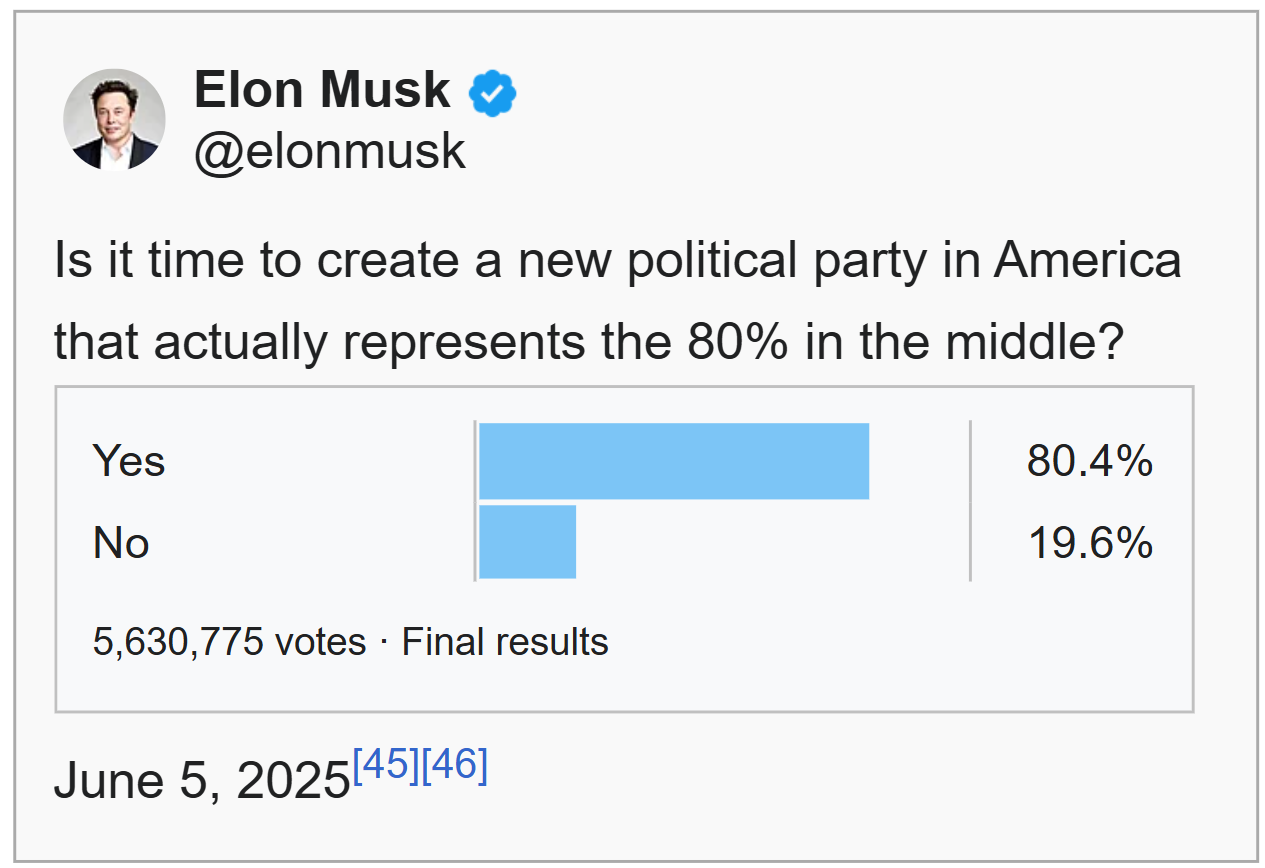
All I wish to point out is that Musk is an erratic, petulant child who throws away his relationships and prospects, proposes huge projects like the “America Party” out of spite, and cannot keep a cool head when his ego is threatened.
This is not businesslike behaviour. As Howard Hamlin says, I cannot be business partners with someone whose judgement I don’t trust.
Elon Musk is a monster, by the way. He propelled DJT into the White House because he wanted attention. He dismantled USAID because he believes that black and brown people’s lives in the developing world are worth less than those of Americans. And when Grok, his cash-burning AI vanity project, started deepfaking images of women and girls in bikinis without their consent, he thought it was funny.
When an investor bets on a high-profile tech company, they have to bet on people as much as operations. And Elon is not a leader I am willing to bet on.
And yes, I know that I already am (or I probably will soon be) an investor in SpaceX by proxy. When SpaceX joins the S&P 500 sometime in 2027, SpaceX will enter my portfolio whether I want it to or not. I can handle that; as an S&P 500 index fund investor I’m betting that the US economy will continue to grow, not SpaceX.
But a small part of my long-term investments are indeed single stocks. I invest in companies whose operations, objectives, and people seem so exceptional to me that I want more exposure to them. Even if Grok 5 becomes the best LLM in the world, and even if SpaceX comes up with some brilliant plan to mine trillions of dollars of unobtainium on Mars, SpaceX will continue to fail my litmus test so long as Elon Musk is at the helm.
This phrasing is doing me too many favours: among other flaws with me and James’ design (which was mostly based on Kerbal Space Program logic), the science fair had like 40 entrants total and there were prizes for solos AND pairs across like 4 age categories. So technically half of everyone there “won”.
I find myself a little skeptical of Starlink as a long-term operation. Technology Connections points out just how absurd of a solution it is, and while it’s genuinely amazing tech that has saved lives, it seems to me that it’s far easier for traditional telecomms to penetrate Starlink’s market share than vice versa. It’s cheaper to run some fiber optic cables than it is to launch more satellites. I can see a future where Starlink has fewer and fewer customers as global infrastructure improves. But I won’t deny that short-medium term, Starlink is an excellent product.
Actually I sort of do. I saw him in these great interview videos from WSJ. I just don’t remember his name off the top of my head (nor should I, perhaps.)
Yeah I agree... I tried to get in on the IPO itself, but missed it. But at this point it's just too expensive, it feels like everyone is just going in on the bubble of the word "space" and elon musk.
(disclaimer: that's also what I thought about Tesla and yet Tesla stock kept steadily rising)